Howdy, it’s been a bit since I’ve had a chance to really revisit one of these kinds of things. When the Internet first gained mainstream acceptance back in the late 1900’s, there were oh so many of these kinds of things floating around. The efficiencies gained by moving to “digital” mediums upended a lot of assumptions people had about how the world worked, or could work. At the close of the 20th Century, such high-minded speculations was rampant, and all saw the future coming.
Then 9/11 happened, and Jeffrey Epstein took over the intellectual world…and we stagnated for some reason.
Note: I am not overselling Epstein’s influence on the “high-minded thinkers” of the early 21st Century. He was at the center of it all, and he was hedonistic nihilistic zionist. This is well documented, as is how his history of connections to nearly every movement of the aughts and 2010’s until his arrest in 2019. Look into the “Sante Fe Institute” and “prominent mathematicians and theoretical physicists” for more insight into how deep his pockets (and therefore influence) actually went.
Why is Epstein relevant to Palantir?
Because this is actually Epstein’s Philosophy, just with Alex Karp’s words. This “world” they envision has a direct line to Epstein’s hopes for the future. And it’s a fairly dark one (if you aren’t one of the chosen few who are above it all).
There is a bit of background here (re: Epstein’s Philosophy). There is long video interview (available via the DOJ’s Epstein Library) that covers it pretty well. The horses mouth, as it were. DocumentID EFTA01600824 for the deeply curious (it’s a .mov file).
So it *matters* what rich guys who are going to fund the next generation of science think and do. Hence the analysis below.
That all being said, here’s a link to the full thread laying out the 22 main themes of “The Technological Republic: Hard Power, Soft Belief, and the Future of the West, by Alexander C. Karp & Nicholas W. Zamiska” (in a single link). I’ll respond to each point below.
The Technological Republic, in brief.
If only it were that brief. This will go for a bit, and probably leave more questions than answers. I seriously doubt the full book has the full answers, because the summary does not summarize them with those tantalizing details (like who are the bad cultures, see #21).
1. Silicon Valley owes a moral debt to the country that made its rise possible. The engineering elite of Silicon Valley has an affirmative obligation to participate in the defense of the nation.
Silicon Valley owes a *financial and intellectual debt* to the country that created it. Both the freedom to innovate and long-term government investment in pure science and research are why it ever existed. The word “elite” will be doing a lot of work in Alex Karp’s worldview, and the definition changes depending on if it’s talking about him (good) or other people (bad). Here, he is part of the “engineering elite” that only does software…which is odd, considering that a “software engineer” mainly shares only an overlap in terms with something like “electrical engineer” or “chemical engineer” and after Calculus, both learn entirely different things in school.
Regardless, the notion of a “moral debt” is hard to parse, especially considering how he wants to pay it back is by telling everyone else how wrong they are.
2. We must rebel against the tyranny of the apps. Is the iPhone our greatest creative if not crowning achievement as a civilization? The object has changed our lives, but it may also now be limiting and constraining our sense of the possible.
lowhut? Get out of the valley, bro. Look, convergence has been an interesting thing. The ability to run a business from a handheld computer that can can also make voice and video calls is amazing, but calling it a “phone” at this point is just lazily reductive. We have reduced computer size and and increased power to the point that one can carry around a machine capable of doing anything number of things, from running a business to tweeting and entire civilization into the ground. This leads to levels of utility that humans are still learning to adapt to, but it’s the mobile computer part, not the “phone” part that makes that possible. And wireless internet.
These are great technologies, but that’s all they are. What has happened *around that* is the concentration of wealth created by that utility. The walled gardens of apps stores and 20-30% off the top. Those are the bigger issues: concentration of wealth, gate-keeping and rent-seeking.
3. Free email is not enough. The decadence of a culture or civilization, and indeed its ruling class, will be forgiven only if that culture is capable of delivering economic growth and security for the public.
Yeah…especially since that “free 15GB” is now eaten up by a few long videos of that concert you’ll totally watch again. What we need, demand, etc, is the same thing your average billionaire demands, total freedom and our own space fleets.
The notion that there is a “ruling class” at all should be very alarming to folks. That we should be worried about their feelings, doubly so.
Also, I think universal healthcare and education are the real first demands. Then the 30-hour work-week and “Retire-55” movement should gain some steam as people realize we are living in the 21st century now, and billionaires do not work for their wealth (it’s mainly lobbying, as we see here).
4. The limits of soft power, of soaring rhetoric alone, have been exposed. The ability of free and democratic societies to prevail requires something more than moral appeal. It requires hard power, and hard power in this century will be built on software.
This is a total yikes moment. “Soft power” is absolutely NOT just rhetoric. Rhetoric is rhetoric, power is power. They are different things. Soft power was, for example, USAID. Here we had *access* and *influence* across the world and got that *by helping people*. Also, incredibly useful for inserting various intelligence assets because now we have relationships and *trust* built by action. None of that is “rhetoric”. Soft power isn’t just a “moral appeal,” it is integrity, it is action, it is consistency. All aligned with the rhetoric, as it were.
Software is…not hard power. They are quite distinct, as we’ll explore it a further down the line here. Software is (it’s in the name) soft. Yes, many of our best weapons systems are driven by software, as are our vehicles. But the software controls the *hardware*, and without that, it’s so soft as to barely exist at all.
This is beyond “putting the card before the horse”. This is “we don’t need a cart at all, we have a horse!” thinking. This kind of myopia seems to be the actual major theme of the book.
5. The question is not whether A.I. weapons will be built; it is who will build them and for what purpose. Our adversaries will not pause to indulge in theatrical debates about the merits of developing technologies with critical military and national security applications. They will proceed.
This is just dumb reasoning for the Prisoner’s Dilemma. Not even taking a moment to understand the situation or the dynamics of the situation. Only “The Government must proceed with massive contracts directed to my and my friends companies.” Sadly, that kind of self-interest, while never acknowledged, is again a theme of the entire work here.
The question is how to give humans the power to leverage such systems to make decisions. The idea of letting the A.I. make the final call *in any situation* is a fool’s errand, nothing more than entertainment. This, I think, is the actual fight here philosophically. A.I. is a *tool*, it is not a *god*.
6. National service should be a universal duty. We should, as a society, seriously consider moving away from an all-volunteer force and only fight the next war if everyone shares in the risk and the cost.
The *next* war??? This is very odd because the United States is currently losing a war with Iran where they are winning the propaganda war with off-the-shelf AI video generation models. Also, the idea that everyone has to agree to let A.I. win the war for us is, again, just non-sensical. There are a lot of contradictory ideas going on here. “Everyone” is again doing a lot of vague work here.
Also, recall that the Iran War for the Strait of Hormuz (’26) opened with the United States bombing a girls school and killing a similar number of people that died in the Oklahoma City terrorist bombing in our own history. That targeting was provided by Palantir.
7. If a U.S. Marine asks for a better rifle, we should build it; and the same goes for software. We should as a country be capable of continuing a debate about the appropriateness of military action abroad while remaining unflinching in our commitment to those we have asked to step into harm’s way.
Empty pablum. And again, folks have *volunteered* to step into harm’s way. The rest of us are supposed to make sure their leaders aren’t demented old rapists.
8. Public servants need not be our priests. Any business that compensated its employees in the way that the federal government compensates public servants would struggle to survive.
This one is even weirder. In the United States, with our First Amendment, priests have no place in government, so I don’t even know what this is a response to. It’s contradicted by multiple other bullet points.
Also, and again, public service and private corporations are two distinct entities with different fundamental goals. Conflating the two is always going to be problematic (government works to internalize risk, business works to externalize it). Regardless, we are about to “celebrate” the 250 year anniversary of our government. Most companies last less than a year, much less a generation, to speak nothing of centuries.
The constant drive for more profit is NOT A SURVIVAL INSTINCT. It’s often at odds with the concept, as private equity shows us again and again.
9. We should show far more grace towards those who have subjected themselves to public life. The eradication of any space for forgiveness—a jettisoning of any tolerance for the complexities and contradictions of the human psyche—may leave us with a cast of characters at the helm we will grow to regret.
It’s important to understand these these folks (like Karp) have so normalized having a rapist felon as President, they somehow warn that *someday* someone bad might take power. The lack of awareness is paramount. It’s always been the case that being a Republican required a total *lack* of self-awareness, but now it’s just about totally ignoring Republicans like Donald (who raped children and is a convicted felon and has no morals whatsoever).
It’s clear folks like Karp don’t *regret* Donald. Indeed, they celebrate him. This completely undercuts any point they might be trying to make here.
10. The psychologization of modern politics is leading us astray. Those who look to the political arena to nourish their soul and sense of self, who rely too heavily on their internal life finding expression in people they may never meet, will be left disappointed.
Alex Karp would *really* like you all to stop telling him to get therapy.
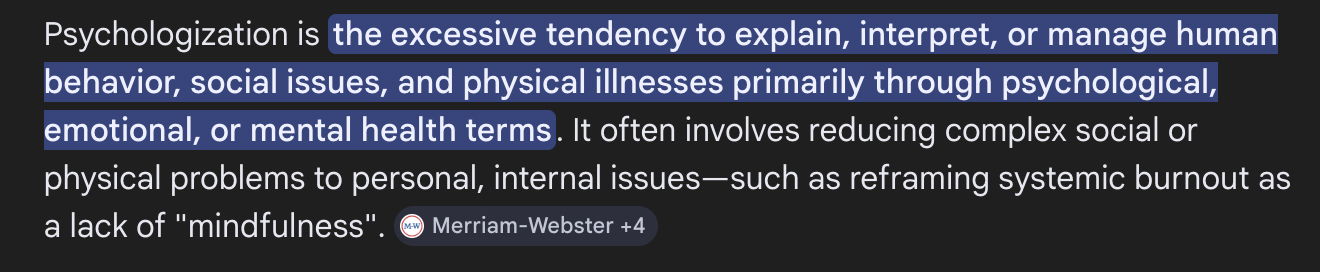
What’s wild here is the “people they have never met” bit. His entire Palantir targeting platform is about targeting people for destruction that, I have to assume, he has never met.
11. Our society has grown too eager to hasten, and is often gleeful at, the demise of its enemies. The vanquishing of an opponent is a moment to pause, not rejoice.
Sorry, what was that about hard power again? This is just non-sensical and completely lacking in what was apparently a very specific context in the mind of the writer (Alex’s ketamine habit, perhaps?).
12. The atomic age is ending. One age of deterrence, the atomic age, is ending, and a new era of deterrence built on A.I. is set to begin.
Yeah, that doesn’t make sense. Iran targeting data centers in the middle east with cheap ass drones should really set the level for this kind of thinking. What is the deterrence here? “Do what we say or we will release the latest AI model in your direction?” Seriously, what’s the threat? Hacking? AI propaganda?
13. No other country in the history of the world has advanced progressive values more than this one. The United States is far from perfect. But it is easy to forget how much more opportunity exists in this country for those who are not hereditary elites than in any other nation on the planet.
Back those bad “elites” now. This seems a really odd one, especially as those “progressive values” are now being dismissed as naive. It’s weird to take credit for something you also think is fundamentally flawed.
14. American power has made possible an extraordinarily long peace. Too many have forgotten or perhaps take for granted that nearly a century of some version of peace has prevailed in the world without a great power military conflict. At least three generations — billions of people and their children and now grandchildren — have never known a world war.
This is SUPER DUPER WIERD as Joe Biden ended the longest war in American history in 2021. AND WE ARE CURRENTLY AT WAR! This also ignores Vietnam…like it never even happened. This is a very strange re-telling of the second half of the 20th Century and the first 20 years of the 21st. Just super weird.
15. The postwar neutering of Germany and Japan must be undone. The defanging of Germany was an overcorrection for which Europe is now paying a heavy price. A similar and highly theatrical commitment to Japanese pacifism will, if maintained, also threaten to shift the balance of power in Asia.
This is even stranger in the light of 13 and 14 right above it. It’s like some ketamine whiplash logic. What “heavy price” is Europe paying? We would be kicking Russia’s ass if Donald (see #9 above) would just fund Ukraine. Is this assuming Japan would be counter to China? That’s even more nuts.
16. We should applaud those who attempt to build where the market has failed to act. The culture almost snickers at Musk’s interest in grand narrative, as if billionaires ought to simply stay in their lane of enriching themselves . . . . Any curiosity or genuine interest in the value of what he has created is essentially dismissed, or perhaps lurks from beneath a thinly veiled scorn.
Ayayaya! Holy cow! Won’t someone thinkg of the poor downtrodden billionaires who get no respect? How about y’all just pay your taxes? And not get huge kickback and government contracts while decrying “socialism”? This one just reeks of…well…see the response to #10. This is why people keep saying that.
Elon is *clearly and obviously* a white supremacist. He had made this abundantly clear with his posting over the last few years. One would assume that would *matter*, but then you read #21, and realize that Karp does not have any issues with that kind of thinking.
17. Silicon Valley must play a role in addressing violent crime. Many politicians across the United States have essentially shrugged when it comes to violent crime, abandoning any serious efforts to address the problem or take on any risk with their constituencies or donors in coming up with solutions and experiments in what should be a desperate bid to save lives.
This one is strange, disconnected, self-serving and also very Twitter-brained. Violent crime in the United States is at a 50 year low. You have to go back the 1960’s, nearly 60 years ago, to find anything similar. And again, that was *before all the progress noted in #13. We made the progress, crime has gone down. This should be celebrated! Instead, we have the bogeyman of “violent crime (committed by those from bad cultures)” as the justification for massive AI driven surveillance (and the requisite huge government “non-socialist” contracts).
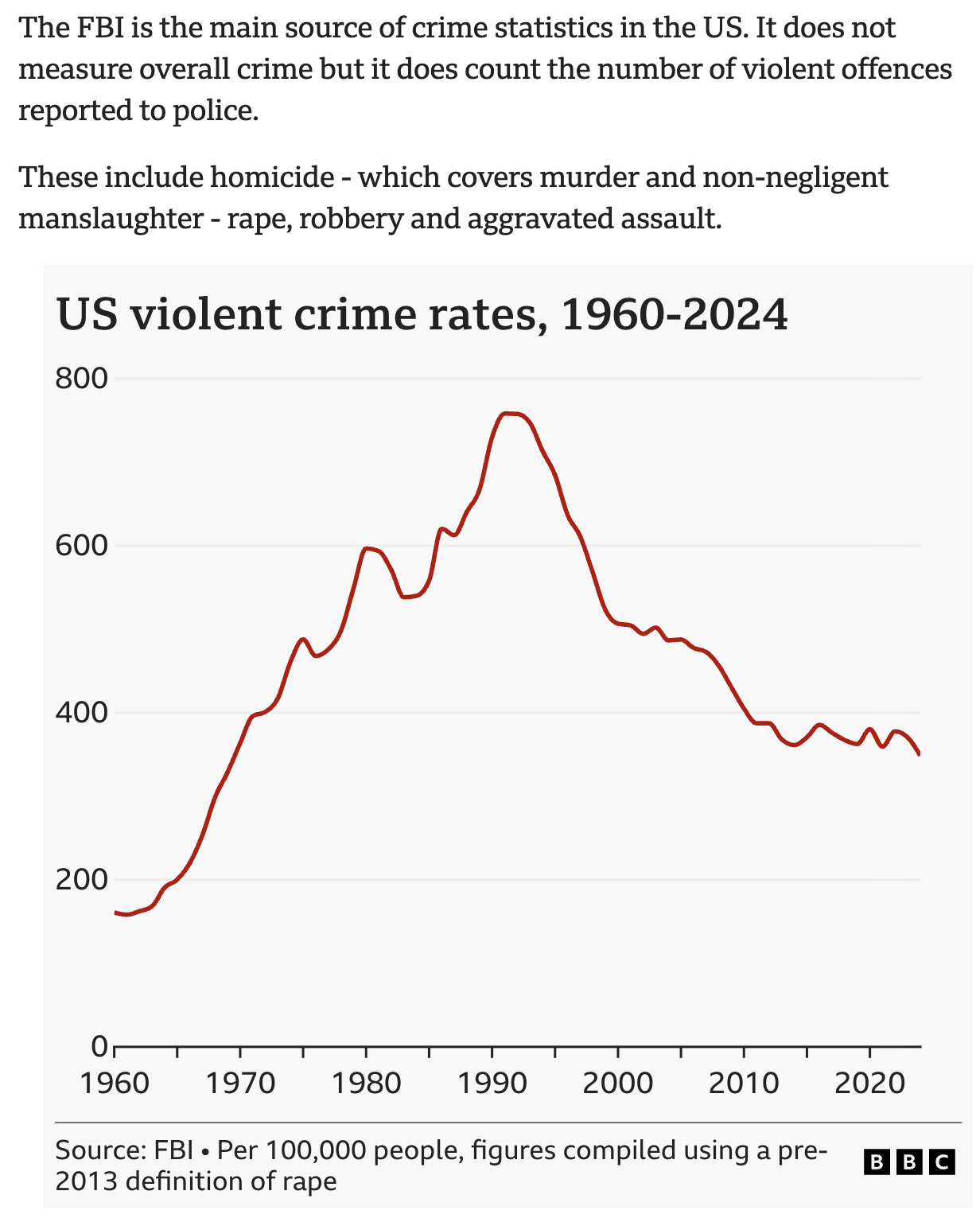
Violent crime in the United States is lower now than at any other point in my life. I am 51 years-old.
18. The ruthless exposure of the private lives of public figures drives far too much talent away from government service. The public arena—and the shallow and petty assaults against those who dare to do something other than enrich themselves—has become so unforgiving that the republic is left with a significant roster of ineffectual, empty vessels whose ambition one would forgive if there were any genuine belief structure lurking within.
Nut up, buttercup. This is just billionaire grousing. Name names or stop whining. Again, we see you folks. We are not that impressed. Also, note how this contrasts with #8. Are we using too much scrutiny on our “priests”? Again, this stuff doesn’t make sense from point to point.
19. The caution in public life that we unwittingly encourage is corrosive. Those who say nothing wrong often say nothing much at all.
Not to belabor the points, but DONALD FUCKING TRUMP THE DEMENTIA DRIVEN RAPIST is currently President. You can’t keep acting like we’ve not already hit rock bottom and everyone is as decent and buttoned up as Biden was.
20. The pervasive intolerance of religious belief in certain circles must be resisted. The elite’s intolerance of religious belief is perhaps one of the most telling signs that its political project constitutes a less open intellectual movement than many within it would claim.
This is a new definition for “intolerance” that I am simply not aware of. Also, those “elites” are back and they are bad again this time. Religious belief is largely fading in the United States and other countries because it’s just wrong. The Internet, Education, Literacy, these are all anathema to religious beliefs. Supernatural explanations for natural phenomenon are just not needed any more. This is a bit of a personal axe to grind, but grow up, tech bro. Your religion, their religion, ALL THE SUPERNATURAL SHIT IS BULLSHIT.
That’s not “intolerance” by the way, it’s just calling something what it is. That this debate is lost by the religious each time they actually attempt to engage honestly with it is not lost on literally everyone else with a brain watching.
The Internet has allowed this to happen at light-speed, generationally. This is something, the widen enlightenment of our species, that Silicon Valley should be taking some credit for, not shying away from. Helping to build the tools that allow for the conversations that can lead to the Embiggenment of Man are good, actually.
Your religion is not the answer. Wake up and keep looking. Be honest about your arguments. See how far they go.
21. Some cultures have produced vital advances; others remain dysfunctional and regressive. All cultures are now equal. Criticism and value judgments are forbidden. Yet this new dogma glosses over the fact that certain cultures and indeed subcultures . . . have produced wonders. Others have proven middling, and worse, regressive and harmful.
But you just said..??!?!! Anyway, “some” is doing a lot of work here, “others” is hiding what is probably some stupid religious-race-based bigotry. These kinds of vague fill-in-the-blank-with-cultures-you-hate stuff is rampant nowadays, and very Twitter-brained.
Who are these “others”, Alex? Which are the regressive and harmful cultures? Will you tell us? Or do you assume we *all just know* (wink, wink).
22. We must resist the shallow temptation of a vacant and hollow pluralism. We, in America and more broadly the West, have for the past half century resisted defining national cultures in the name of inclusivity. But inclusion into what?
Shallow and vacant, indeed. Inclusion into what?????!! Did you see the crime stats for the last 50 years you just mentioned? This progressive movement has incorporated the world into American culture, but you dumb bigots won’t get off your damn computers to see it. Progressivism won, mostly. Just not economically (see: Class, Epstein).
Sorry, this sucks because I love tech and built my career around it. It’s paid for my house, and my family, but I NEVER HAD TO KILL PEOPLE TO MAKE MONEY!
That’s what he’s trying to justify here. That’s why it’s so incoherent. This is a morally broken screed from a deeply lost and confused man…with billions of dollars in defense contracts and AI’s that kill. And he wants praise for those choices.
Give him none.
Excerpts from the #1 New York Times Bestseller The Technological Republic: Hard Power, Soft Belief, and the Future of the West, by Alexander C. Karp & Nicholas W. Zamiska
BTW, the Co-Auther here is a tool as well. A weird, VERY MYOPIC, VERY IGNORANT about military history tool.
Note: think about if this guy wants to build a better life for *everyone* or a small number of people as he talks.
Hint: Epstein’s Vision did not include 8,000,000,000 other humans (it’s just a royal class and then their fodder).

